Monday, 28 July 2008

Dragons, leeks and daffodils: our national emblems


Think of Wales and you think of the red dragon, the heraldic symbol of the Principality that features on our national flag.

This mythical creature has come to symbolise the fiery Welsh, proud and defiant in the face of adversity - usually in battles with the English.
Legend has it that the symbol of the red dragon was sported on a crest by Arthur, son of Uthr Bendragon. It was said that the father had seen a dragon in the sky predicting his son would be king.
Other, more likely explanations of how the dragon came to be associated with Wales, can be more readily verified.
The dragon symbol probably found its way into Wales via Rome, when the Roman legions arrived on our shores sporting the mythical, fire-breathing creature as an emblem.
In the Medieval era Welsh poets would compare their brave leaders to dragons and between 1485 and 1603 the dragon formed part of the arms of the Tudor dynasty.
It surfaced again in the 19th century when it appeared as the royal badge for Wales in 1807. From then onwards the red dragon was frequently used as a symbol in Welsh patriotic societies and was finally officially recognised by the Queen in 1959.
Other national emblems include the daffodil and the leek.
The leek has the older association with Wales with references to this green and white plant dating back to the six-century poet Taliesin.
The leek is also mentioned in 13th century Red Book of Hergest which contains manuscripts of the Welsh mythological tales known as The Mabinogian.
Eating leeks was believed to encourage good health and happiness and they were worn by the Welsh in the Battle of Crecy in 1346.
It has been suggested, too, that the green and white family colours of the Tudor dynasty are taken from this most Welsh of symbols.
By the time Henry VIII - whose father Henry VII founded the Tudor dynasty - presented a leek to his daughter on St David's Day in 1536, the leek was firmly associated with Wales.
St David is, of course, the patron saint of Wales and the patriotic wear small, ornamental leeks and daffodils on March 1 to celebrate the Principality's own saint's day.


In contrast, the daffodil is a much younger emblem, gaining popularity in the 19th century. Women, especially, were fond of this bright, cheerful flower as an emblem of Wales.
At the beginning of the 20th century it became even more closely associated with the Principality when Welshman and British Prime Minster David Lloyd George wore it on St David's Day and at ceremonies to mark the investiture of the then Prince of Wales.

BBC hopes Merlin magic can rival Doctor Who


by Catherine Mary Evans, Western Mail

AN ALL-STAR drama based around one of Wales’ oldest legends will become the BBC’s latest attempt to rival the prime-time success of Doctor Who.
Merlin, which is currently being filmed in Wales and France for BBC1, is set in the mythical town of Camelot and follows the fabled friendship between the young wizard Merlin and Prince Arthur.
The 13-part family drama series, due to hit our screens in September, is set in a time before Arthur becomes king, as Merlin comes to terms with his magical powers.
Newcomer Colin Morgan, 22, from Northern Ireland, takes the lead role as Merlin. His previous television experience is limited to guest roles on Doctor Who and the Catherine Tate Show. However, he has made a name for himself in the West End with critically acclaimed roles in Vernon God Little and All About My Mother.
Morgan is joined by rising star Bradley James, who plays the young Arthur Pendragon, long before he took the sword from the stone and became King. James, 23, has previously appeared in an episode of ITV's detective drama Lewis.
Up-and-coming actress Angel Coulby, who has also appeared in Doctor Who and ITV police drama Vincent, stars as Guinevere.
The young performers’ acting skills will be put to the test alongside acting heavyweights such as veteran John Hurt and ex-EastEnder Michelle Ryan.
Bafta-winner Hurt will provide the voice of the young Merlin's mentor, the Great Dragon, while Bionic Womanstar Ryan will play wicked sorceress Nimueh. The role will be Ryan's first part since Bionic Woman, which was dropped following disappointing ratings in the US. Ryan has also been signed up to star in ITV1's new romantic comedy Mr Eleven, although this is not expected to air until late autumn.
BBC Wales’ head of drama Julie Gardner, also an executive producer on Doctor Who, said: “In this new version, Merlin and Arthur are young contemporaries for the first time ever, bringing a much loved tale to a whole new generation with a fresh, youthful new look and approach for Saturday nights.”
“John Hurt plays Merlin’s mythological mentor and the only dragon left with magic powers. It is an absolute privilege to be working with him.”
Heroes star Santiago Cabrera, who played Isaac Mendez in the hit US drama, will take the role of Lancelot.
One Foot in the Grave’s Richard Wilson and Buffy the Vampire Slayer’s Anthony Head take on the roles of court physician Gaius and Arthur’s father King Uther Pendragon respectively.
Guest stars include Eve Myles, Will Mellor, and Green Wing’s Julian Rhind-Tutt.
BBC bosses hope the tale will appeal to young and old audiences alike, and will fill the hole left by David Tennant’s absence in Doctor Who, which occupies a similar Saturday night slot in the schedules.
Merlin, which is being made by production company Shine – the International Emmy Award-winning production team behind Hex and Sugar Rush – through BBC Wales, will be broadcast from September in the Saturday 7pm slot previously filled by Doctor Who and Robin Hood.
Johnny Capps of Shine Television said: “We have a wonderful cast and fantastic locations, which we hope will bring alive the magic and myth of Camelot for a new audience.”
The series has already been sold to a number of international broadcasters by distributor FremantleMedia Enterprises, including NBC in the US and CTV in Canada.

Wednesday, 23 July 2008

Welsh claim to origins of the Holy Grail


Jul 12 2008 by Robin Turner, Western Mail

The allure of the Holy Grail has fascinated writers and ensnared knights for more than 1,000 years.
From Malory to Monty Python, the eternal chalice – said to be the very cup from which Jesus drank at the last supper – has become enshrined as one of popular culture’s most spiritual icons.
But while Scotland has been given the credit for being the Grail’s final resting place – thanks largely to Dan Brown’s hugely-successful novel The Da Vinci Code – a new book by a Welsh academic says Wales’ claim to the relic is stronger.
Since The Da Vinci Code was published in 2003 it has sold more than 60 million copies and been made into a blockbuster movie.
It has also led to hundreds of thousands of visitors making a pilgrimage to Rosslyn Chapel near Edinburgh, which the book claims is the Grail’s final resting place.
But Grail expert Dr Juliette Wood of Cardiff University, a New York-born Welsh convert, said theories linking the Grail to Scotland were relatively new.
“Wales’ associations with the Grail stretch back to the 14th century,” she said.
Dr Wood, who specialises in Welsh folklore and Celtic literature, dismisses Brown’s assertion that the Grail was discovered by the Knights Templar who buried it beneath one of the pillars of Rosslyn Chapel.
“Stories in the past century have tended to romanticise the Knights Templar as some kind of special forces of Christianity but in reality they were simple soldiers, admittedly brave, but ultimately they followed orders,” said Dr Wood, who is also secretary of the Folklore Society in London.
“Dan Brown’s book has certainly revived interest in the Grail but when it talks about masonic involvement and the Knights Templar, it goes too far.
“The story about Rosslyn Chapel’s links with the Grail is only about 20 years old.
“Wales’ link is much stronger. Wales has Arthurian romances which refer to the Grail, but Scotland doesn’t have that. There are a number of Holy Grail romances written in Scotland but there has not been anything found in Gaelic.”
Dr Wood said possibly the strongest association Wales had with the Grail came from the story of Peredur the Son of Evrawc, which appears in the Mabinogion.
“There are strong links between Peredur and the Knight Percival from the King Arthur romances.
“The two are not the same but there are strong similarities between them,” she said.
“The story of Peredur of Wales is that he sets out on a quest to find the Grail.
“In a castle one night, it appears not as a shining beacon, but in the form of his cousin’s head, floating on a platter or dish in a pool of blood.
“Peredur then avenges his uncle by slaying the nine witches of Gloucester.
“What happens to the Grail after the death of the witches however is a mystery, it appears to disappear into the mists of time.”
Other theories which link the Grail to Wales include an ancient Celtic myth surrounding the Nanteos Cup, a sacred life-giving cauldron, thought to have been the basis for many Grail stories.
More recently a theory was put forward by former Western Mail journalist and bard, Owen Morgan, who claimed the Grail was not an object but the beautiful landscape of Wales.
Many further meanings have been devised for the Grail, which has been linked to the Celts and King Arthur, the eucharistic rites of Eastern Christianity, ancient mystery religions, Jungian archetypes, dualist heresies, Templar treasures and even the alleged descendants of Christ and Mary Magdalene.
The common thread running through all the stories is the assumption that the Grail legend has a single source with a meaning that is concealed in the romances themselves.
“I think the enduring fascination of the Grail is its elusiveness, it’s like a puzzle no-one yet has solved and people see it as a challenge, just like the ancient knights,” said Dr Wood, who left New York at the age of 23 to learn Welsh, but ended up staying.
“I saw a postcard in a shop in Aberystwyth depicting the Nanteos Cup and I became hooked on the Grail legend and its associations with Wales ever since.”
Eternal Chalice: The Enduring Legend of the Holy Grail (I.B.Tauris, £18.99), is out now

King Arthur "was Welsh" say French academics

Jul 1 2008 by Darren Devine, Western Mail


French historians have suggested King Arthur was indeed a Welshman despite years of English “spin” claiming the mythical figure as their own.
As part of a major conference into the legend, academics say that if the king ever existed he was probably from Wales with strong links to Brittany, in northern France.
And far from being English – a ploy, they say, to appeal to nationalist sentiment – he would actually have been the sworn enemy of the Anglo-Saxons.
The organisers of the event at Rennes University, in Brittany, say the fable of Arthur and Camelot has been continually updated by English nationalists keen to bring back the Age of Chivalry.
Being held next month, the conference and exhibition – King Arthur a Legend in the Making – will suggest English historians, artists and writers conspired to create a fictitious national hero.
Curator of the Rennes exhibition Sarah Toulouse said: “These stories deal with universal themes. The earliest fragments of the tales can be traced back to Wales in the seventh century.
“But by the 13th century stories based on the Arthurian legends were being told right across Europe.”
When the British Empire was at its zenith, writers like the Victorian poet laureate Alfred Lord Tennyson depicted King Arthur as an upstanding Englishman whose masculine virtues saw him try to create heaven on earth.
Mrs Toulouse added: “King Arthur is a mythical figure who was invented at a certain point in history for essentially political reasons.”
The tales of Camelot, Excalibur and Arthurian derring-do have long been popular throughout Europe, with the earliest images of the king found in Italy, dating from about 1120. They also quickly spread as far apart as Iceland and found particular popularity in rural Brittany, although French historians have not gone as far as trying to claim the king as French. “It would be out of the question for us to say that,” said Mrs Toulouse.
Alan Wilson, a Welsh authority on Arthur, agreed with many of the conference’s claims, even claiming he has discovered evidence the monarch famed for his Knights of the Round Table lived and died here.
He says the nation is missing out on a tourism bonanza by ignoring our connections to the legendary leader.
In the early 1980s Mr Wilson, along with Arthurian co-author Baram Blackett, found what they claimed was the King’s memorial stone at the small ruined church of St Peter-super-Montem on Mynydd-y-Gaer, near Bridgend.
A decade later, after using deep ground metal detection equipment, the two say that a cross weighing 2.5lb with an inscription reading “Pro Anima Artorius” (For The Soul Of Arthur) was among several articles discovered. They say the National Museum of Wales was offered both items for analysis, but the offer was declined.
Mr Wilson said despite writing to Culture Minister Rhodri Glyn Thomas about the strength of Wales’ claims on King Arthur, his work is being ignored here.
The writer, who is originally from Cardiff but who now lives in Newcastle, claims historical records from the life of St Illtyd, Arthur’s cousin who buried the monarch, show his body was taken up the Ewenny River.
It was later placed in a cave near Pencoed following his death in 579AD, says Mr Wilson.
The 76-year-old author, whose latest work on the leader was the King Arthur Conspiracy, said the King’s body was then moved to the church where it was buried under a crypt.
Mr Wilson, who believes Arthur’s mythical kingdom of Camelot was in an area now known as Castlefield in Cardiff, said, “I gave them (Assembly officials) copies of our books last year and met the First Minister Rhodri Morgan’s private adviser.”
Mr Wilson, who worked in shipbuilding as a master planner and received commendations from both the Italian and Swedish Governments, added: “The Culture Minister [Rhodri Glyn Thomas] was due to meet us, but ducked out at the last minute. We’ve sent them documents within the last six weeks.
“But it seems the Welsh establishment don’t want tourists. We’ve made monumental discoveries that could create a tourist bonanza like you can’t imagine. You’re sitting on a tourism gold mine in Wales.”
A spokesman for Assembly tourism organisation Visit Wales said overly exploiting every part of Wales said to have connections to Arthur would ruin the visitor experience.
He added: “In addition, the Arthurian story is not unique to Wales since many other parts of the UK and France can claim and demonstrate strong links with the great legend.”
Laying claim to the legend
Almost every corner of the UK has laid claim to the legend of King Arthur. Here we highlight just a few of the places associated with the King:
Authors Alan Wilson and Baram Blackett say Arthur’s kingdom of Camelot was in the Castlefield area of Cardiff.
Tintagel, in Cornwall, has also had a long association with Arthur and the area’s castle is said by local legend to have been the King’s fortress.
Glastonbury Abbey has been taken to be the Isle of Avalon, where Arthur was said to have gone to be healed of his wounds following the Battle of Camlann in 537. Late tradition assumes that he died and was buried there. Other legends have it that the Island of Avalon is the Isle of Aval in northern Brittany.
Stories of King Arthur holding court at Caerleon, near Newport, stretch back to the time of Geoffrey of Monmouth in the 12th century and further still to the oral traditions set down in the Mabinogion.

The Mabinogian: tales of myth and legend


No self-respecting lover of Welsh literature would be without a copy of The Mabinogian, the classic collection of Welsh tales that draws on our Celtic roots and pagan ancestry.
Believed by some scholars to have been written over a period of time between 1060 and 1250, the tales of Welsh myth, history and legend were translated in the 19th century by Lady Charlotte Guest (1812-1895).
It was she who called them Mabinogian, the plural of Mabinogi meaning 'a story for the children'.
There is no one author of The Mabinogian, the tales were added to over the years and kept alive by traditional storytellers and travelling Bards.
The manuscripts she translated are held in Jesus College, Oxford, and are contained in the Red Book of Hergest. There is also a White Book of Rhydderch, the earliest of the two books, which can be dated back to 1325.
Each tale in the four main sections of The Mabinogian tells the story of members of Royal Welsh households: Pwyll the Prince of Dyfed; Branwen, the Daughter of Llyr; Manawyddan, the Son of Llyr and Math, the Son of Mathonwy.
As with most ancient texts their stories undoubtedly started life as homages to pagan gods and goddesses later becoming entwined with more contemporary references to Christianity and royalty.
The legendary King Arthur is also featured. The story of Culhwych and Olwen is set in Arthur's court and includes a list of his knights.
Arthur is also featured in The Dream of Rhonabwy, a story of King Arthur and his knights, fairy heroes and Celtic warriors.
Other tales of Arthur and his knights' adventures include The Lady of the Fountain, Geraint the Son of Erbin and Peredur the Son of Evrawc.

Tuesday, 22 July 2008

Rare Viking Sword Fragments Unearthed on Isle of Man

Two highly decorated parts of the Viking sword recently discovered. © Manx National Heritage


By 24 Hour Museum Staff
06/05/2008

Dan Crowe and Rob Farrer discovered the artefacts whilst metal detecting in the north west of the island.
Both Dan and Rob are experienced metal detector users and have found many interesting artefacts over the years, so they knew the importance of what they had found and reported it to Manx National Heritage.
“This is only the 13th recorded Viking sword from the island," said Manx National Heritage Curator for Archaeology, Allison Fox.
"Even though they had done exactly the right thing by not cleaning the surface dirt from the finds, when they brought them into the Manx Museum it was clear straight away that we had something very special indeed."

(Above) Five parts of the Viking sword superimposed to show how the sword may have looked. © MNH
The most decorative part of a Viking sword was usually the handle, or hilt, and it is part of this that has survived over one thousand years in the soil.
Rather like a set of knuckles, the pommel (the top part of the sword) design is divided into 5 parts, or lobes, each with intricately carved designs. In between the lobes are sets of finely twisted silver wires – a technique seen a few times on artefacts from the Isle.
The artefacts have now been donated to the Manx National Collections by the landowner.
Further research will be carried out on the sword before it is permanently displayed in the new Viking and Medieval Gallery at the Manx Museum, Douglas. During the interim period, the sword fragments will be on display in the foyer of the Manx Museum from Monday May 12.
Manx Museum

Kingswood Grove, Douglas, IM1 3LY, Isle of ManT: 01624 648000Open: Mon-Sat 1000-1700Closed: 25 - 26 December and 1 Jan


Celtic Pantheon


Britain

Baletucadrus – God which name means ‘What glittering’
Cocidius – God associated as in forests as in hunting (similar to Roman God Silvanus or Mars)
Condatis – Goddess who personifies the join of two rivers in Tyne-Tess in North Britain
Coventina – Goddess of fountain (whom says she got the power of healing)
Cuda – Mother Goddess

Latis – Goddess associated with water

Matres Domesticae – Aspect of three mothers, who were considered goddesses of lands (Britain)
Mogons – God which name means ‘The Great’, was highly bowed in North Britain

Nodens – God of Healing, relationed to Irish God Nuada

Sulis – Goddess of Healing, Goddess relationed to fountains of warm waters of Aquae Sulis (where is the Bath city, in England, compared to Roman Goddess Minerva).

Galia

Abnoda – Goddess of Hunting, similar to Goddess Roman Diana
Andraste – Goddess of Victory

Belenus – God of light, which name means ‘what shine’
Borvo – God of healing, which name is associated to spring water

Cernunnos – God of fertility and animals

Damona – Goddess of fertility and healing, which name is translated as means ‘Divine Cow’
Dispater – Roman God which represents the hell, his cult toward to Galia

Epona – Goddess of horses
Esus – God similar to Mars and Mercury

Nantosuelta – Goddess of Nature, Sucellus’ wife
Nehalennia – Goddess of Sea

Ogmios – God of eloquence and knowledge

Rosmerta – Goddess which native consort was Mercury, her name means ‘The Great Provider’

Surona – Goddess of Healing

Sucellus – God of agriculture and forests, is known as God of Hammer, which name means ‘What slaughter’

Taranis – God which name means Thunder, compared to Roman God Jupiter

Teutates – God of War

Wales


Arianrhod – Goddess which name means Deusa cujo nome sugnifica ‘Silver Circle’, Goddess of Moon

Blodeuwedd – Lady of Flowers, Lleu Llaw Gyffes’ wife

Branwen - Llyr’s daughter

Dewi – God who was represented for a Red Dragon, which became symbol of Wales
Don – Mother Goddess, equivalent to Irish Goddess Danu

Govannon – God of smithers and another works with metals
Gwynn ap Nudd – God of Hell

Lleu Llaw Gyffes – equivalent to Irish Lugh

Llyr – God of Sea

Mabon - Modron’s son, warrior

Math or Mathonwy – God of Magical Arts

Modron – Goddess which name means Mother Goddess

Pryderi - Pwyll and Rhiannon’s son

Pwyll – Prince of Dyfed and Mabnogion hero

Rhiannon - Pwyll’s wife

Taliesin – Renowned Bard, which name means ‘Face that shine’


Ireland

Aine – Goddess of Love

Banbha – one of threes Goddess who Ireland name come from.

Boann – Goddess of water and fertility, who brought Oenghus to Daghda

Brigit (Brighid) – Goddess of Fertility, healing and poetry

Cailleach – Which name means ‘Old Lady’, represents the Old Wiselady; Lady of Wise

Cerridwen – Goddess, Lady of Caldron, Lady of knowledge caldron, Goddess of Grains

Cian - Lugh’s father

Cliodna – Goddess of Beauty and the Otherworld

Criedhne – God of works with metal (smithers), one of three Gods of manufactured works from Tuatha De Danaan

Daghda – God of Earth, leader from Thuatha De Danaan

Danu / Dannan – Great Mother, mother of the Thuatha De Danaan

Dian Cecht – God of arts of healing

Donn – God of deads, ‘The Dark’

Eriu – second of three Goddess that Ireland name come from
Fodla – third of three Goddess that Ireland name come from

Goibhniu – second of three gods of manufatured works of the Thuatha De Danaan

Luchta – third of three gods of manufatured works of the Thuatha De Danaan

Lugh – God of Sun, which name means ‘What Glittering’

Macha –Goddess of War and Fertility, known as ‘Macha, the raven’

Morrigan – Goddess of War and Death, has a triple aspect, Daghda’s wife

Nechtan- Goddess of Water, which fontain is known as ‘The Knowledge Fountain’

Néit- God of War, Nemhain’s husband

Nemhain- Goddess of War and battle
Nuada- Thuatha De Danaan’s King

Oenghus- God of Youth and Love

Ogma- God of eloquence and language

Quote: Dictionary of Celtic Mythology
Writer:Peter Berresford Ellis


Wednesday, 9 July 2008

The Literary Archetypal in King Arthur


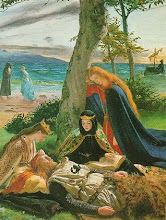
In the antiquity, people did not obtain to explain the phenomena of the nature, through scientific explanations, however, created the myths, whose purpose was to give sensible the things of the world and the life. The myths also served as a form to pass knowledge and to alert to the people about dangerous or defects and qualities of the human being. Therefore, it has, a difference between legend and myth, while legends look for to give explanations to the mysterious events or supernatural things, the myth, consists in a strict symbolic component of narration.On the other hand, it fits to unmask the archetypal figure of the dragon, called “the divine serpent”, which brings the mark of the "uruboros", being about the primordial cohesion of the unconscious one, symbolized by the circle, the egg, the ocean, the divine serpent, mandala and the first essence that the alchemycal “uroboros” appraises. Being thus, the fertile womb of the Great Mother is expressed through the images of the day, the sea, the source, the land and the cave. In this period of training, it would correspond to the rejourney of the child in the maternal womb, the death and the birth have fight every night, and the existence before and after the death is identical. However,it corresponds to the incestuous union between Arthur and Morgan his half-sister verifying that in the Celtic Tradition it could be interpreted not aslike an “incestuous delivery” but a 'delivery' or 'offer' to the Great Mother. Therefore Morgan/Morgana, drift of the celtic word morgans that it means “fairies of the water” or "daughters of the sea". Thus, I perceive, that the “uroboros” and its sovereignty is strictly on the matriarcal question, or either, the matriarchy while been psychic, associates to the land and absolutely relationed to unconscious nature, in contraposition of the culture.In turn, the child “rising I” is presented however as vulnerable, however as accompanying to the Holy Ghost of the Great Mother, as loving its, detainer of an existence not properly individual, but ritualistic. The occurrence of the removal of the parents (in the direction of the child disconnect itself of them), after whom properly the world appears, the conscience and the culture if oppose. The moving on of “conscientious I” from the unconscious one is express for archetypal of the fight. The separation of the parents that occurs to the son is analogous to the fight with the dragon. Anyway, “I” if it becomes the hero as first personality, that if he bases as the archetypal precursor of the humanity as a whole.The reasons of the fight against the dragon and the fights against the monsters and the sorcerers occupy an important place in the story of the magic. Thus, the basic facts of the heroes result in the attainment from the Ctonic world, of cultural or natural objects, in the construction of the human world, as prohibited of the cosmos, constituted against the forces of the chaos and as defence of state-tribe.Thus, Vladimir I. Propp (2006) has arrived to interpret the story of the magic as clarifying myth of the iniciatic rite or neophyte. The initiation implies in the temporary of the community, contacts with other demonic worlds and its inhabitants, painful provations, temporary death and subsequent resurrection. In addition, it fits to point out the alegoric present in Arthur’s Death, the 'death' of Arthur is an alegoric personificated in the speech, and fits to emphasize a dealing associated to a visible neophyte rite, which can assign as a Triad. This triad unfolds in:
1/ The conception of Arthur through the magic;
2/ Arthur himself becomes King when he is is fifteen years old, pulling a sword of the stone, Excalibur, the “Sword of the power” that also its forges is supernatural;
3/ the love-affair triangle that involves Arthur, Guinevere and Lancelot and consequently breakdown the kingdom of Camelot and culminates in tragedy;
4/ The present ambiguity in the 'death' of Arthur, a death that does not exist body, estimating the resurrection and the return of only King Arthur to govern Britain. Constructed this triad, I explain that number three is sacred and perfect, represents the sides of a triangle representing the beginning, the middle and ending.Being this base, it is the Holy Ghost in principle, whichever represents the Son, the return to the community, it is the Holy Trinity, it is the sign of the return and the purification of the inner forms. It fits to remember that this triad produces what Gilbert Durand (1988) defines as mythlogems of the imaginary, whichever are mythical redundances in determined culture, motifs that are replaced through the times. Being thus, Gilbert Durand considers four mythlogems:
1/ The founder hero;
2/ The seek for the impossible, in the medieval narratives, treating itself to find the “paradise lost”, in Arthurian myth would be the Isle of Avalon or 'Island of the Apple-trees', that in the Malory's book is placed in the quagmires of Glastonbury, such as, this intertext sends us to the 'Fortunate Island' as shown in Greek mythology;
3/ The occult rescuer;
4/ The transubstanciation or transmutation, the 'wait' for a body, hope for a king, the death/ressurrection of Arthur, in which fulfills to the prophecy who Sir Thomas Malory said: “King Arthur was King and he will always be King”.The myth emphasizes the subject of the death as necessity of 'changings' and transformations of state. In truth, the death does not exist and the iniciatic death purposes moralize. In this way, conserving the nucleus of the archetypal image of the hero, the chivalry romance not only “civilizes it”, but it opens to the Epic hero an “inner content” to the “special” man.

Chivalric Prayer


Chivalric Prayer

unknown~

God grant me prowess

In all things, that He make me sharp of mind as with skill.

As my preparation for all temptation, be my blade against it.

God grant me courage

That He grant me the heart to accept loss as well as gain.

To face these things cleanly, to know humility from it.

God grant me honesty

That He give me Spirit to keep all oath, be true of heart as well as mind.

To be in honour to others and self, be my salvation against acceptance of weakness of virtue.

God grant me loyalty

That He bless me with the understanding of my station in duty and responsibility.

To honour always my bonds of fealty to those responsibilities, be they of inner or outer source.

God grant me generosity

That He may stay me from accusations to the honour of others and their actions upon me

That I may speak in earnest and give my heart breadth to be of virtue to others as they with me.

God grant me faith

For in this alone lay the foundation to my virtue and honour, may it be granted strength.

So that in times of duress may it be strong in spirit and be my shield.

God grant me courtesy

Through this grace may He give me the kindness to temper honesty that it may not be wroth

In face of trespass done unto me that it may be tempered by largesse to forgive.

God grant me franchise

Through Him grant me nobility of heart that all virtue should rest within me always for all time.

Thus let it be mine armour in time of great test, always worn, and glorious in care.

God grant me chivalry and its virtue

Through Your power and will alone is this granted

Through these do I serve and am replenished.

Amen.

Friday, 4 July 2008

Major Exhibition of Arthurian Tales


So France is about to become the centre of the Arthurian World when this month Rennes will be the home for a series of events on the legend of King Arthur.

On July the 15th, A major exhibition on Arthurian tales will run for six months and will be called "King Arthur: A Legend in the Making"."The earliest fragments of the tales can be traced back to Wales in the seventh century," Sarah Toulouse, one of the exhibitions curators, told AFP. "But by the 13th century stories based on the Arthurian legends were being told right across Europe." According to Toulouse she said that "King Arthur is a mythical character who was invented at a certain point in history for essentially political reasons". "If he had really existed there would be more concrete historical traces of him."On the Same day as the start of the Exhibition, the International Arthurian Society begins it's 22nd Annual Congress at Rennes University.

The society brings together experts on Arthurian tales from across the world and is open to both Arthurian academics and amateur enthusiasts. Formed in the Breton city of Quimper in 1948, it meets every three years. For more info on the society's history go to:


The Congress was last held in Britain in 2002 when it visited Bangor. I am told that the Congress is well worth attending and runs from the 15th to the 20th of July. For more info go to:


Keep up to date with the progress of Warner Bros. film production of 'The Once And Future King' but you can also visit the main page. http://www.thependragon.co.uk/OnceAndFutureKingFilm.htm